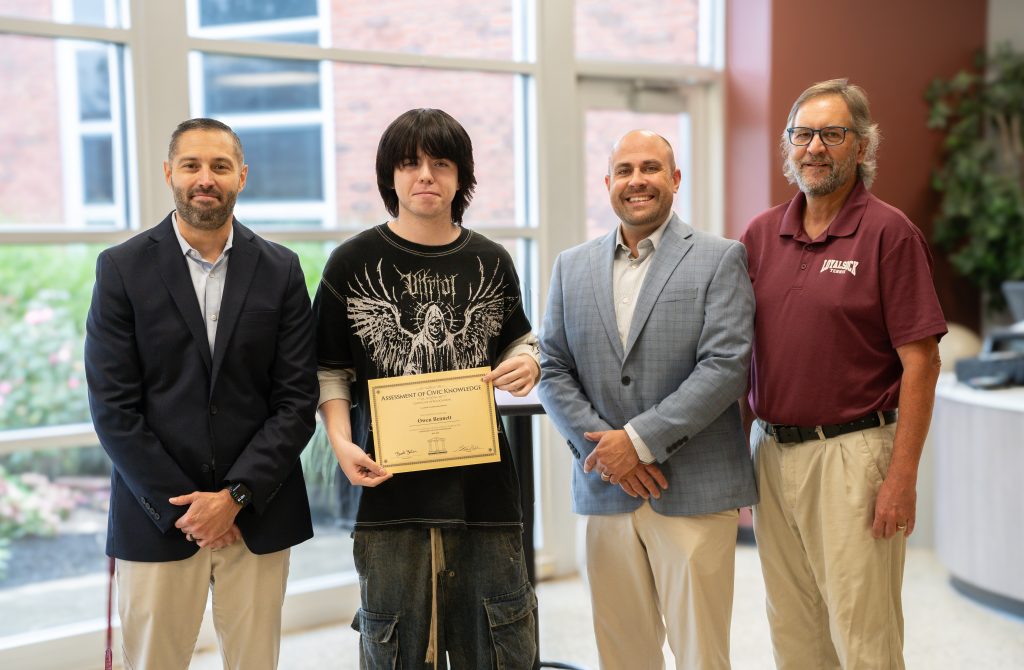
WILLIAMSPORT, Pa. (SEPT. 18, 2026) — Loyalsock Township High School senior Owen Bennett has been recognized for earning a perfect score of 100% on the Pennsylvania civics assessment administered at the conclusion of the civics course last school year.
Required under Act 35 of 2018, the assessment measures students’ knowledge of U.S. history, government and civics, including the nature, purpose, principles and structure of constitutional democracy; the principles and operations of the U.S. government; foundational government documents; and the rights and responsibilities of citizenship.
Bennett was the only one of 100 students in the district who completed the assessment to earn a perfect score.
In recognition of his achievement, Bennett received an official Certificate of Achievement from the Pennsylvania Department of Education. He was recognized by now-retired civics teacher Kirk Bower and LTHS principals, Stephen Hafele and Richard Cummings.
WILLIAMSPORT, Pa. (SEPT. 18, 2026) — Loyalsock Township High School senior Hannah Bastian will represent the Lancers this fall as the school’s contestant in the queen competition at the 77th annual Pennsylvania State Flaming Foliage Festival in Renovo.
Bastian, the daughter of Annemarie and Romain Bastian Jr., is among the contestants vying to be crowned the 2026 festival queen.
Bastian said she is excited for the opportunity to represent her school and community.
“It is such an honor to represent Loyalsock in the Flaming Foliage Festival,” she said. “I am so excited to dazzle the judges with my bright personality.”
“We are so excited to have Hannah representing Loyalsock this year,” said Vickey Campman, an LTSD counselor. “We haven’t had a student representative attend since before COVID, so bringing this opportunity back to Loyalsock feels really special, and we know Hannah will represent us so well. She is such a wonderful example of our school community: deeply talented, incredibly involved and someone who genuinely makes Loyalsock a better place. We are so proud of Hannah and can’t wait to cheer her on.”
An active member of LTHS and local community, Bastian has participated in activities throughout her high school career, including theater, band, jazz band, choir, Dramatic Society, Key Club, Student Council, FBLA, Spanish Club, volleyball and several music and academic honor societies.
She has held leadership positions as president of the International Thespian Society and Choir and historian of FBLA. Previously, she served as vice president of the Thespian Society and Choir and secretary of the Thespian Society and FBLA.
Her involvement extends beyond the school community. Since 2015, she has volunteered and performed with the Community Theatre League in Williamsport, where she has served as an actress, usher, greeter, concession worker, sound operator and marketing assistant. She also assists with preserving and organizing historical materials for the organization.
Following graduation, Bastian plans to attend a university to study meteorology and atmospheric science. She hopes to become either a broadcast meteorologist or a forecast meteorologist.
The festival is a longstanding North Central Pennsylvania fall tradition that celebrates the region’s autumn scenery and brings visitors to Renovo for a weekend of events. The three-day festival features a queen competition and coronation, parade, arts and crafts show, talent show and other family activities.
This year’s festival runs Friday, Oct. 9, through Sunday, Oct. 11. Bastian will be escorted by 2026 LTHS graduate Elijah Burger.
Walk through the halls of Donald E. Schick Elementary School during language arts instruction and you will quickly feel the energy in the K-2 classrooms. Students are engaged and eager to participate as teachers guide lessons filled with conversation, decoding practice, writing, repetition and encouragement. Across each classroom, young readers are building confidence and discovering the joy of learning to read.
Whether students are working in small groups, reading aloud with a partner or practicing new phonics skills together, every lesson is designed with one goal in mind: building strong, confident readers.
At the center of that work is Enhanced Core Reading Instruction, known as ECRI.
Implemented as an enhancement to the Core Knowledge Language Arts (CKLA) curriculum this year, ECRI provides teachers with research-based instructional strategies that strengthen foundational literacy skills while giving students consistent opportunities to practice, respond and grow.
ECRI has become more than just a program. It has become a daily part of instruction.
“And we’re already seeing positive results,” said Terri Deitrick, Title 1 coordinator and reading specialist. “Students are becoming more confident, more engaged and more comfortable with the daily routines because there’s consistency from classroom to classroom.”
WHAT ECRI LOOKS LIKE
In classrooms across the building, instruction is intentional, structured and highly interactive.
“You’ll hear teachers and students working together through structured routines and repeated practice that help build reading accuracy, fluency and comprehension,” Deitrick said.
Teachers lead students through routines focused on phonemic awareness, phonics, fluency, vocabulary and comprehension — all critical components of early literacy development. Students respond as a group, practice sound patterns, read connected text and receive immediate feedback from their teachers.
The routines are designed to maximize engagement and provide repeated opportunities for students to master essential reading skills.
“The students are responding actively and working collaboratively,” said Jaime Feerrar, second-grade teacher. “There’s a lot of structure, routine and consistency, but there’s also a lot of energy in it, which keeps everybody actively engaged.”
“That consistency creates a common language for both students and teachers — and ultimately our families,” Deitrick said. “Instead of spending time figuring out how a lesson works, students can focus their energy on learning and growing as readers.”
Students move fluidly between whole-group instruction, collaborative practice and individualized support. Teachers use data to identify student needs and adjust instruction to ensure every child receives the support necessary to succeed.
“My students have grown to trust the predictability of the ECRI program as well as trust their own growth in the process,” said Tonya Knittle, first-grade teacher. “Some children who may have reading difficulty early on are now more confident and ask to read more.”
Kindergarten teacher Maggie Brooks says ECRI routines also have led to significant growth in students’ early literacy skills, particularly in decoding and reading confidence.
Brooks noted that incoming kindergarten students arrive with varying letter-sound knowledge, making it challenging to bring everyone to the same starting point. Now, she sees students building automaticity with letter sounds and progressing more quickly into decoding and reading fluency.
“It has empowered them to become stronger readers much sooner than we typically see in kindergarten,” Brooks said.
She also said students are more eager to participate in reading activities and are developing a stronger sense of independence as readers.
“I’ve seen their confidence soar because they feel more equipped,” she added. “They want to read — they look forward to reading.”
SUPPORTING TEACHERS, SUPPORTING STUDENTS
A major strength of the program’s implementation has been the commitment of faculty and staff.
Teachers have spent significant time training, collaborating and refining instructional practices to ensure consistency across grade levels. That collaboration allows educators to share strategies, examine student growth and continuously improve instruction.
“What we’ve been doing this year is using mini professional development, which has been very beneficial because our teachers aren’t out of the classroom for extended periods of time,” said Head Principal Marc Walter. “It’s small doses — in about an hour, hour-and-a-half trainings — which they then can immediately take back to their classroom and use.”
District leaders praised the efforts of the building’s staff for embracing the work focus.
“I commend our teachers, paraprofessionals and administration for their commitment to strengthening instruction and intervention practices in support of our students,” said Superintendent Dr. Brooke Beiter. “The progress we’re already seeing is a reflection of the excellent work happening in our classrooms each day.”
A FOUNDATION FOR THE FUTURE
By investing in evidence-based instructional practices during the earliest school years, Schick Elementary is helping students build a foundation that will support them throughout their academic journey.
“I think what’s most beneficial right now is that our students aren’t going to have to learn new strategies and new processes and procedures when they transition from each grade level,” Walter said. “They’re already going to be carrying those skills with them from the grade level prior, and we’re going to have a level of instructional consistency across our building, which will then help our students moving forward and will also help our teachers collaborate between each other in their grade levels and also between grade levels.”
As students continue to grow as readers, Schick Elementary teachers remain focused on meeting learners where they are, celebrating progress and ensuring every child has the tools needed to succeed.
###
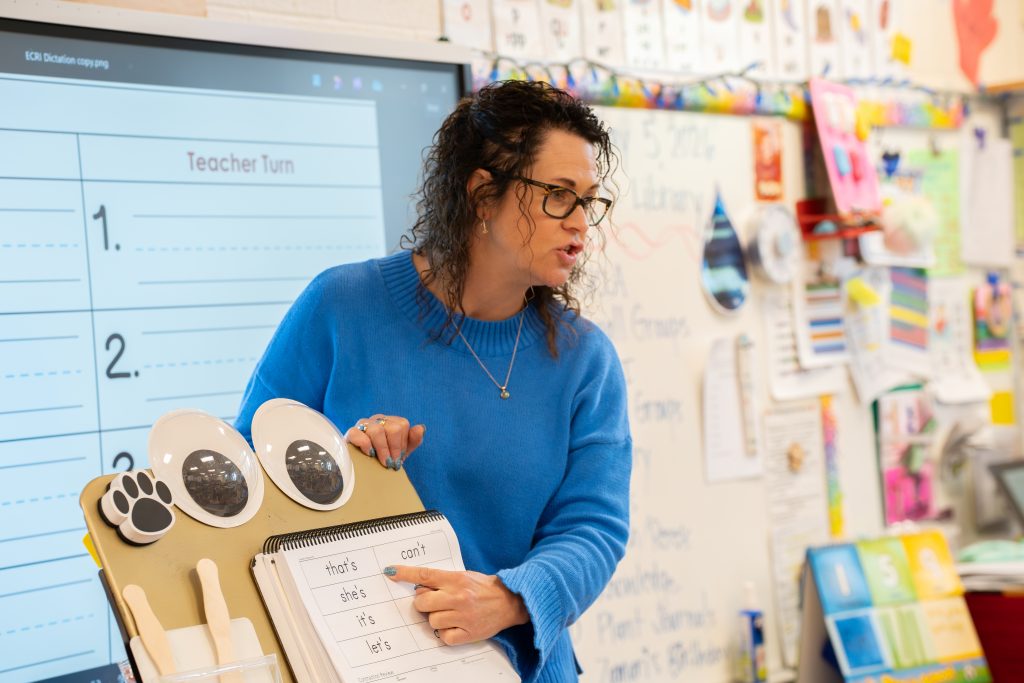
At top, Schick Elementary second-grade student Quentin Gallagher reads along the page during an ECRI routine in Jamie Feerrar’s classroom last spring. Above, first-grade grade teacher Tonya Knittle teaches an ECRI lesson to her students.
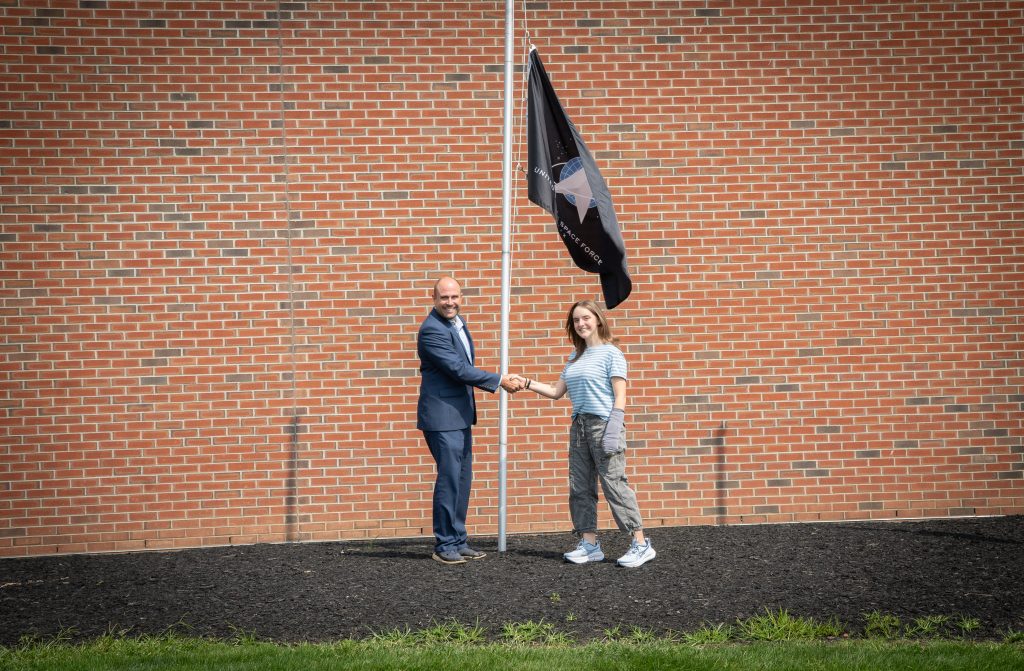
WILLIAMSPORT, Pa. (SEPT. 1, 2026) — Loyalsock Township High School’s military flag display now represents all six branches of the U.S. armed forces, thanks to the initiative of one LTHS junior.
After noticing that the U.S. Space Force was the only branch not represented on the display outside the high school, junior Gia Biacchi decided to do something about it. More than 100 hours of work later, Biacchi’s service project culminated Monday with a ceremony dedicating the new Space Force flag in front of the entire student body.
Although rain prevented the flag from being raised during the ceremony as planned, the dedication marked the completion of Biacchi’s effort to add the newest branch of the U.S. military to the school’s display.
The ceremony included performances by the LTHS band, participation from members of the Korean War Veterans of Lycoming County and representatives from the other five branches of the military.
Biacchi’s project grew out of her participation in the Hugh O’Brien Youth (HOBY) Leadership Conference last spring, where students are challenged to complete 100 hours of service in their communities. The project was made possible in part through a donation from Jung Martial Arts Family Center, a veteran-owned business that provided the new Space Force flag.
“I’m fortunate to come to a school that supports student initiatives,” Biacchi said.
She chose the project after realizing that Space Force was missing from the school’s military flag display and felt it was important that the newest branch of the armed forces be represented alongside the others.
“The current flag displays were initiated through a student project,” said Richard Cummings, secondary principal, who opened Monday’s ceremony and worked closely with Biacchi on the effort. “It is only fitting that the students continue this tradition to keep our military flag display updated. The district has always been a strong supporter of our United States military as well as community service.”
“Today, Loyalsock Township High School is doing more than finishing a flag display,” said Staff Sgt. Conner Bentley, a U.S. Air and Space Force recruiter. “You’re recognizing history while it’s still being written.”
Bentley encouraged students to view the Space Force flag as a symbol of future possibilities, noting that the Space Force did not exist when many of their parents and teachers were in high school. He said today’s students can pursue careers in areas such as cyber operations, intelligence, engineering and space systems, while other careers and challenges they will encounter may not yet exist.
“I hope this flag honors the guardians serving today, inspires the people who may serve tomorrow, and reminds everyone who sees that service comes in many different forms,” Bentley added.





 WILLIAMSPORT, Pa. (SEPT. 18, 2026) — Loyalsock Township High School senior Owen Bennett has been recognized for earning a perfect score of 100% on the Pennsylvania civics assessment administered at the conclusion of the civics course last school year.
 WILLIAMSPORT, Pa. (SEPT. 18, 2026) — Loyalsock Township High School senior Hannah Bastian will represent the Lancers this fall as the school’s contestant in the queen competition at the
  From the pages of
  SUPPORTING TEACHERS, SUPPORTING STUDENTS
 WILLIAMSPORT, Pa. (SEPT. 1, 2026) — Loyalsock Township High School’s military flag display now represents all six branches of the U.S. armed forces, thanks to the initiative of one LTHS junior.