




 WILLIAMSPORT, Pa. (SEPTEMBER 8, 2026) — Walk through the halls of Donald E. Schick Elementary School during language arts instruction and you will quickly feel the energy in the K-2 classrooms. Students are engaged and eager to participate as teachers guide lessons filled with conversation, decoding practice, writing, repetition and encouragement. Across each classroom, young readers are building confidence and discovering the joy of learning to read.
Whether students are working in small groups, reading aloud with a partner or practicing new phonics skills together, every lesson is designed with one goal in mind: building strong, confident readers.
At the center of that work is Enhanced Core Reading Instruction, known as ECRI.
Implemented as an enhancement to the Core Knowledge Language Arts (CKLA) curriculum in the 2025-26 school year, ECRI provides teachers with research-based instructional strategies that strengthen foundational literacy skills while giving students consistent opportunities to practice, respond and grow.
ECRI has become more than just a program. It has become a daily part of instruction.
“And we’re already seeing positive results,” said Terri Deitrick, Title 1 coordinator and reading specialist. “Students are becoming more confident, more engaged and more comfortable with the daily routines because there’s consistency from classroom to classroom.”
WHAT ECRI LOOKS LIKE
In classrooms across the building, instruction is intentional, structured and highly interactive.
“You’ll hear teachers and students working together through structured routines and repeated practice that help build reading accuracy, fluency and comprehension,” Deitrick said.
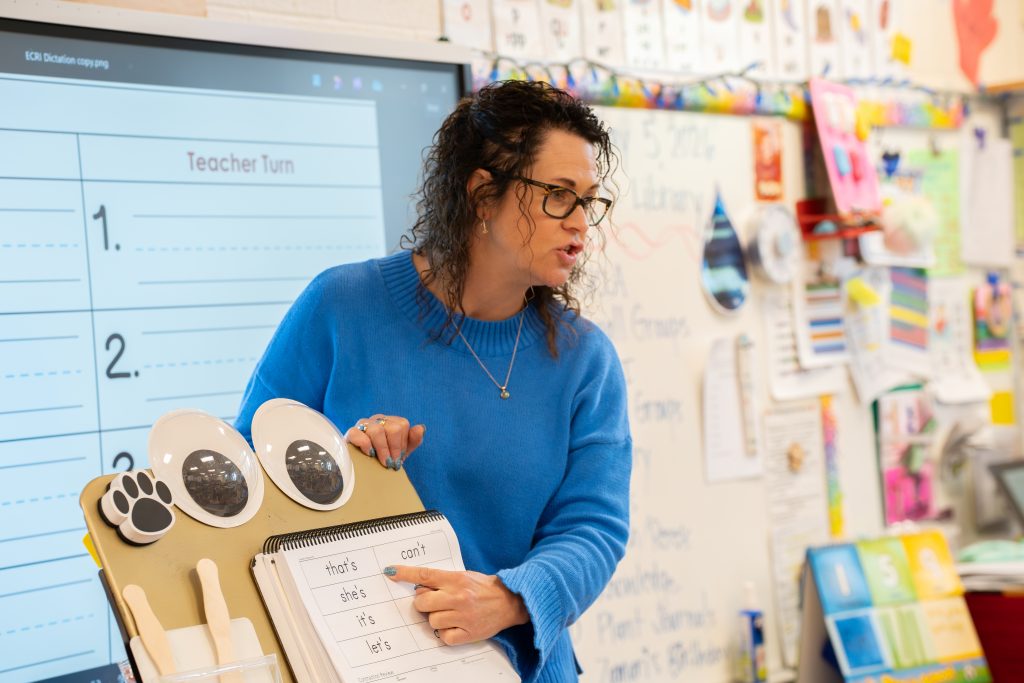
Teachers lead students through routines focused on phonemic awareness, phonics, fluency, vocabulary and comprehension — all critical components of early literacy development. Students respond as a group, practice sound patterns, read connected text and receive immediate feedback from their teachers.
The routines are designed to maximize engagement and provide repeated opportunities for students to master essential reading skills.
“The students are responding actively and working collaboratively,” said Jaime Feerrar, second-grade teacher. “There’s a lot of structure, routine and consistency, but there’s also a lot of energy in it, which keeps everybody actively engaged.”
“That consistency creates a common language for both students and teachers — and ultimately our families,” Deitrick said. “Instead of spending time figuring out how a lesson works, students can focus their energy on learning and growing as readers.”
Students move fluidly between whole-group instruction, collaborative practice and individualized support. Teachers use data to identify student needs and adjust instruction to ensure every child receives the support necessary to succeed.
“My students have grown to trust the predictability of the ECRI program as well as trust their own growth in the process,” said Tonya Knittle, first-grade teacher. “Some children who may have reading difficulty early on are now more confident and ask to read more.”
Kindergarten teacher Maggie Brooks says ECRI routines also have led to significant growth in students’ early literacy skills, particularly in decoding and reading confidence.
Brooks noted that incoming kindergarten students arrive with varying letter-sound knowledge, making it challenging to bring everyone to the same starting point. Now, she sees students building automaticity with letter sounds and progressing more quickly into decoding and reading fluency.
“It has empowered them to become stronger readers much sooner than we typically see in kindergarten,” Brooks said.
She also said students are more eager to participate in reading activities and are developing a stronger sense of independence as readers.
“I’ve seen their confidence soar because they feel more equipped,” she added. “They want to read — they look forward to reading.”
 SUPPORTING TEACHERS, SUPPORTING STUDENTS
A major strength of the program’s implementation has been the commitment of faculty and staff.
Teachers have spent significant time training, collaborating and refining instructional practices to ensure consistency across grade levels. That collaboration allows educators to share strategies, examine student growth and continuously improve instruction.
“What we’ve been doing this year is using mini professional development, which has been very beneficial because our teachers aren’t out of the classroom for extended periods of time,” said Head Principal Marc Walter. “It’s small doses — in about an hour, hour-and-a-half trainings — which they then can immediately take back to their classroom and use.”
District leaders praised the efforts of the building’s staff for embracing the work focus.
“I commend our teachers, paraprofessionals and administration for their commitment to strengthening instruction and intervention practices in support of our students,” said Superintendent Dr. Brooke Beiter. “The progress we’re already seeing is a reflection of the excellent work happening in our classrooms each day.”
A FOUNDATION FOR THE FUTURE
By investing in evidence-based instructional practices during the earliest school years, Schick Elementary is helping students build a foundation that will support them throughout their academic journey.
“I think what’s most beneficial right now is that our students aren’t going to have to learn new strategies and new processes and procedures when they transition from each grade level,” Walter said. “They’re already going to be carrying those skills with them from the grade level prior, and we’re going to have a level of instructional consistency across our building, which will then help our students moving forward and will also help our teachers collaborate between each other in their grade levels and also between grade levels.”
As students continue to grow as readers, Schick Elementary teachers remain focused on meeting learners where they are, celebrating progress and ensuring every child has the tools needed to succeed.
###
Article originally published in “Lancer Life” (Summer 2026)
At top, Schick Elementary second-grade student Quentin Gallagher reads along the page during an ECRI routine in Jamie Feerrar’s classroom last spring. Above, first-grade grade teacher Tonya Knittle teaches an ECRI lesson to her students.
Watch